How Remote Solar Monitoring Is a Game-changer for Homes & Businesses
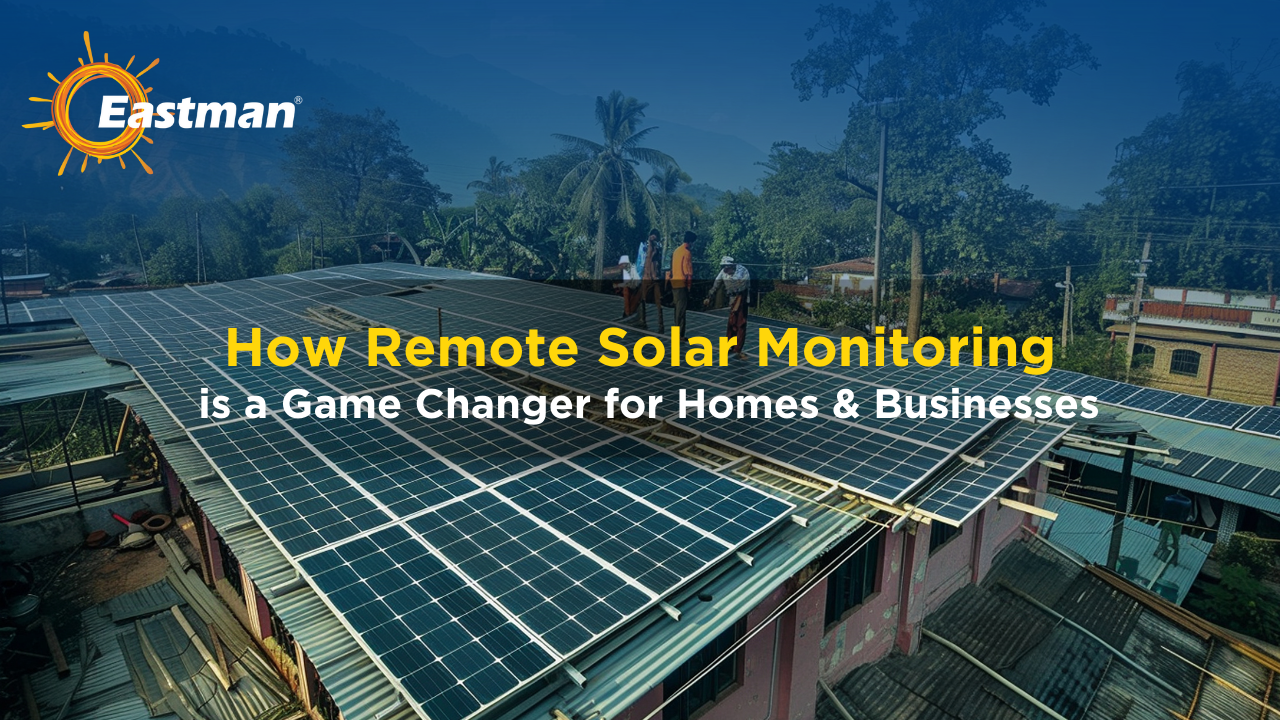
Solar energy systems have evolved far beyond simple power generation units. Today, solar installations are intelligent energy systems that interact with grids, batteries, and loads dynamically. As this complexity increases, remote solar monitoring has become a critical component for ensuring system efficiency, reliability, and long-term returns.
For both residential and commercial users, remote solar monitoring provides real-time visibility into system performance, allowing users to track energy generation, consumption, battery status, and grid interaction from anywhere. Instead of relying on periodic manual checks or waiting for performance issues to surface, monitoring systems enable proactive, data-driven energy management.
In this blog, we explain what remote solar monitoring is, why it matters for homes and businesses, how it works, its key benefits, and how it enhances solar system performance. We also explore how Eastman, through the Eastman One App, delivers reliable and user-friendly remote monitoring solutions.
What is Remote Solar Monitoring?
Remote solar monitoring is a digital system that allows users to monitor and manage their solar power systems remotely via a mobile app or web dashboard. It continuously collects data from solar inverters, Solar PCUs, and hybrid systems, and displays it in real time.
Unlike basic on-site displays, remote monitoring provides:
Anytime, anywhere access
Real-time and historical data
Instant alerts and notifications
Performance analytics and reports
This transforms solar systems into smart, connected energy assets rather than passive installations.
How Remote Solar Monitoring Works:
Remote solar monitoring relies on a combination of hardware, connectivity, and software. It’s step-by-step working is as follows-
Data Capture: Sensors within the inverter or Solar PCU collect data such as voltage, current, power output, battery status, and grid interaction.
Connectivity: A Wi-Fi or GSM communication device (such as the Eastman Wi-Fi/GSM Stick) transmits this data to the cloud.
Cloud Processing: Data is securely stored and analyzed on cloud servers to generate meaningful insights.
User Access: Users access real-time and historical data via a mobile app or web platform.
This ensures continuous monitoring without physical presence at the installation site.
Why Remote Solar Monitoring is important for Residential users
1. Transparency & Trust in Solar Performance
Homeowners often wonder whether their solar system is performing as promised. Remote monitoring eliminates uncertainty by showing live generation data and daily energy savings, building confidence in the system.
2. Early Fault Detection
If solar generation drops due to shading, dust, inverter faults, or connectivity issues, the system sends instant alerts, allowing quick corrective action before losses increase.
3. Smarter Energy Usage
By understanding when solar generation is highest, homeowners can schedule appliance usage, accordingly, improving solar self-consumption and reducing electricity bills.
4. Convenience & Peace of Mind
Whether at work or traveling, users can monitor their solar system remotely, ensuring everything is running smoothly without manual checks.
Why Remote Solar Monitoring is important for Commercial users
For commercial and industrial installations, remote monitoring is not just useful; it is essential.
1. Protecting Large Investments
Commercial solar systems involve significant capital. Remote monitoring ensures that every unit of installed capacity is delivering expected output.
2. Reduced Downtime & Losses
Even a short system downtime can lead to substantial revenue loss. Real-time alerts enable immediate troubleshooting, minimizing downtime.
3. Multi-Site Management
Businesses with multiple solar installations can monitor all systems from a single dashboard, improving operational efficiency.
4. Data-Driven Decision Making
Performance reports and analytics help facility managers:
Optimize energy usage
Plan maintenance
Validate ROI
Support audits and compliance
Key Features of an effective Remote Solar Monitoring
1. Real-Time Power Tracking: Displays live solar generation, load consumption, battery charging/discharging, and grid interaction.
2. Battery Monitoring: For Solar PCU and hybrid systems, monitoring shows:
Battery state of charge
Charging source (solar/grid)
Battery health indicators
3. Alerts & Notifications: Instant alerts for:
Low generation
System faults
Communication issues
Abnormal operating conditions
4. Historical Data & Reports: Users can analyze daily, monthly, and yearly trends to understand performance and savings.
5. Secure Cloud Access: Encrypted cloud storage ensures data security and privacy.
How Remote Monitoring improves ROI
Remote solar monitoring directly contributes to better returns by:
Maximizing energy generation
Reducing downtime
Improving maintenance efficiency
Enabling smarter energy consumption
Extending equipment life
For both homes and businesses, monitoring ensures that the solar system continues to deliver value year after year.
Why Eastman's Remote Solar Monitoring Stands Out
With a strong focus on digital innovation, Eastman Auto & Power Ltd. offers advanced remote monitoring through the Eastman One App, designed for simplicity, reliability, and performance.
Eastman One App: Smart Control in Your Hands
The Eastman one app enables users to:
Monitor inverter and solar performance in real time
Track solar generation, grid usage, and battery backup
Manage multiple devices and locations from one app
Receive instant alerts for faults or performance drops
Access historical data and energy analytics
Enjoy cloud-based data storage (data stored on Indian servers, which means more secure)
The app works seamlessly with Eastman Solar PCUs, hybrid inverters, and grid-tie inverters, making it suitable for both residential and commercial users.
Conclusion
Remote solar monitoring has become a necessity in today’s smart energy ecosystem. For residential users, it delivers transparency, convenience, and better control over energy usage. For commercial users, it ensures performance reliability, reduced downtime, and optimized returns on investment.
As solar systems grow more advanced and interconnected, monitoring is no longer an optional add-on; it is a core requirement. With intelligent features, user-friendly design, and secure cloud access, Eastman, through the Eastman One App, empowers users to take full control of their solar energy systems; anytime, anywhere.
Choose Eastman Solar Solutions with Remote Monitoring and experience smarter, more reliable energy management.
Contact Eastman for more information.
Explore Eastman Solar Solutions.
Get to know your nearest Store Locator for convenience.
FAQ’s
Q. Is remote solar monitoring necessary for small home systems?
A. Yes. It helps homeowners track performance, detect issues early, and maximize savings.
Q. Can I monitor my solar system remotely from anywhere?
A. Yes. Remote monitoring apps allow access via smartphone or web from any location.
Q. Does real-time monitoring help improve solar system efficiency?
A. Yes. By identifying performance issues early, monitoring helps maintain optimal efficiency.
Q. Is internet connectivity required for remote monitoring?
A. Yes. Wi-Fi or GSM connectivity is required for data transmission.
Q. Does Eastman provide a solar monitoring app?
A. Yes. Eastman offers remote monitoring through the Eastman One App.
Keywords: remote solar monitoring, solar monitoring system, solar monitoring app, solar energy monitoring, why remote solar monitoring matters, remote solar monitoring for residential and commercial users.